
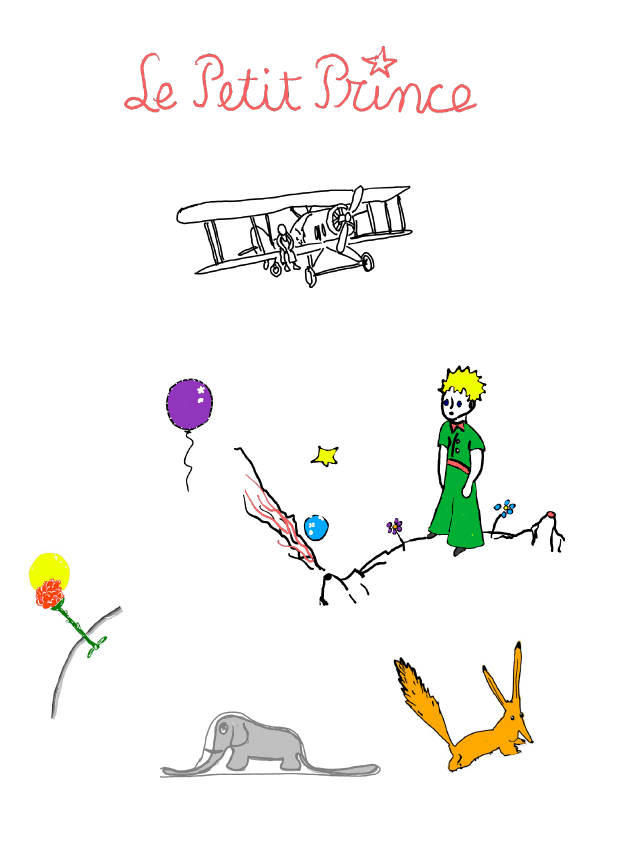
✦ Original French essay followed by the English translation ✦

Table of Contents
The Little Prince by Antoine de Saint-Exupéry
This year, I went back to university to study literature. My first assignment in my class Novel and Globalization was to write a short analytical essay on a chosen novel I’ve already read and find problematic towards globalization. I chose: The Little Prince by Antoine de Saint-Exupéry.
If you enjoy literary classics, you can also explore my full list of book recommendations here. I keep updating it!

Context of the Essay
I enjoyed working on it more than expected, so I shared it here for those who enjoy literature as much as travel.
I wrote the original essay in French for my class, and I’ve included an English translation below.
This is the first of three university essays I’ll be publishing here over the next few weeks.
For those who are curious about the academic side of things, this paper received 78%. I should better understand the notion of problematic and make a clearer link to globalization according to the teacher.
I’ll try to be better next time!

Analyse Le Petit Prince (Original French)
Dans le roman mondialement connu d’Antoine de Saint-Exupéry, le titre porte le nom du protagoniste : Le Petit Prince. Malgré que ce soit l’œuvre d’un auteur français, il a été publié pour la première fois à New York, le 6 avril 1943, par l’éditeur Reynal & Hitchcock et traduit par Katherine Woods[1]. Il sera publié quelques jours plus tard en France, pays natal de Saint-Exupéry.
Le narrateur est un aviateur qui raconte la rencontre extraordinaire qu’il a faite dans le désert du Sahara lors d’un bris de moteur, six ans plus tôt. Aucun signe précis n’indique l’époque durant laquelle se déroule l’histoire. Les dialogues entre l’aviateur et le petit prince nous permettent de découvrir les voyages éducateurs (et moralisateurs) de ce dernier sur différentes planètes et la raison de sa venue sur Terre.
Le petit prince a quitté sa propre planète, car il éprouvait des difficultés émotionnelles avec une rose pour qui il éprouve des sentiments inexplicables qui le tourmentent. À travers ses voyages et ses rencontres, le petit prince montre comment les expériences et les liens affectifs permettent de comprendre l’essentiel de la vie, une leçon qui dépasse largement les frontières culturelles ou linguistiques.
Toutes les relations interpersonnelles, animales, humaines, peu importe la nature de celles-ci, il est primordial de développer un lien durable et solide pour les faire perdurer. Toutes les roses se ressemblent, mais le fait d’en apprivoiser une en particulier, la rend exceptionnelle[2].
La problématique à extirper de l’histoire? Littéralement, du côté du narrateur, ce peut être un moteur brisé qui l’empêche de quitter le désert, sans quoi il n’aurait jamais fait la rencontre du petit prince à travers l’écriture fictive de sa mémoire.
Rien n’est un hasard et cette panne l’aura amené à partager avec le monde entier la rencontre la plus mémorable de sa vie de manière fictive ou non. Une problématique qui s’avère en fait être un élément déclencheur.
Du point de vue du protagoniste, ce pourrait être la quête d’un ami (ou d’un mouton) qui le pousse à partir à l’aventure. Ou bien sa confusion par rapport à ses émotions, ce qui le porte à fuir. La fuite qui l’amène à vivre des expériences, à faire des découvertes et où il peut enfin éprouver le désir de rentrer chez lui, rempli de nouvelles connaissances, de gratitude et d’une maturité nouvelle, ce qui pourrait encore être considéré comme la trame narrative de l’appel à l’aventure.
Si l’on se penche sur l’aspect de la mondialisation de cette œuvre, Le Petit Prince d’Antoine de Saint-Exupéry ne pourrait mieux décrire les effets de la mondialisation, notamment grâce aux traductions d’œuvres littéraires et au partage international d’écrits divers. Il a su également prouver que les émotions n’ont aucune nationalité.
L’auteur étant lui-même un grand voyageur a su transcender ses déplacements dans ce récit et il réussit à faire voyager son lectorat avec lui.
Le texte, bien qu’écrit en français originellement, il a premièrement été publié en anglais, à New York, un an avant la disparition d’Antoine de Saint-Exupéry. Ville des États-Unis dans laquelle l’auteur avait pour mission d’encourager le gouvernement américain à se joindre dans la guerre contre l’Allemagne.
Un roman d’un auteur français traduit et publié de l’autre côté de l’Atlantique avant même de se faire publier chez lui, dans sa propre langue, sur sa terre natale.
Depuis ce jour, le petit prince a été traduit dans plus de six cents langues et dialectes. C’est le deuxième livre le plus traduit dans le monde juste après la bible[3]. À travers les visites du petit prince sur les planètes avoisinantes, l’auteur dénonce de manière enfantine les soucis des grandes personnes. Le fait qu’il a intégré ses aquarelles au texte ajoute une touche visuelle aux mots, qui me rappelle les enluminures du moyen âge.
L’auteur a su évoquer des réalités intemporelles de manière allégorique, à la George Orwell. Le ton enfantin du narrateur, le choix lexical simple et direct, les dessins complémentaires, les dialogues constants qui permettent de découvrir l’histoire et la morale de la fin qui se dévoile avec bienveillance font que celle-ci résonne dans la tête du lecteur, bien longtemps après avoir terminé le livre, peu importe la langue dans laquelle il est lu.
[1] Source Wikipédia.
[2]Référence à l’histoire elle-même.
[3] Selon le Figaro, 2017.

The Little Prince Analysis
First published in New York on 6 April 1943 by Reynal & Hitchcock and translated by Katherine Woods[1]. France, Saint-Exupéry’s native country, published it a few days later.
The narrator is a pilot who recounts the extraordinary encounter he had in the Sahara Desert when his engine broke down six years earlier. There are no specific clues when the story takes place. The dialogues between the aviator and the little prince allow us to discover the latter’s educational (and moralising) journeys to different planets and the reason for his arrival on Earth.
The little prince left his own planet because he was experiencing emotional difficulties with a rose for whom he felt inexplicable feelings that tormented him. Through his travels and encounters, the little prince shows how experiences and emotional bonds enable us to understand the essence of life, a lesson that transcends cultural and linguistic boundaries.
In all interpersonal relationships, whether with animals or humans, regardless of their nature, it is essential to develop a lasting and solid bond in order to make them endure. All roses are alike, but taming one in particular makes it exceptional[2].
The problem to be extracted from the story? From the narrator’s point of view, a broken engine literally may stop him from leaving the desert. Had the engine not broken down, the narrator might never have met the little prince, nor shared this extraordinary memory with the world.
Nothing is random, and this breakdown led him to share the most memorable encounter of his life with the entire world, whether fictional or not. A problem that turns out to be a trigger. From the protagonist’s point of view, it could be the search for a friend (or a sheep) that pushes him to set off on an adventure.
Or his confusion about his emotions, which leads him to flee. The narrative thread of the call to adventure could still be the escape that leads him to have experiences, make discoveries, and finally feel the desire to return home, filled with new knowledge, gratitude, and a new maturity.
If we look at the globalisation aspect of this work, Antoine de Saint-Exupéry’s The Little Prince could not better describe the effects of globalisation, particularly through the translation of literary works and the international sharing of various writings. He also proved that emotions have no nationality.
The author himself was a great traveller and could transcend his travels in this story, taking his readers on a journey with him. Although originally written in French, the text was first published in English in New York a year before Antoine de Saint-Exupéry’s death. This was the city in the United States where the author was on a mission to encourage the American government to join the war against Germany.
A novel by a French author was translated and published on the other side of the Atlantic before even being published in his own country, in his own language, on his native soil.
Since that day, The Little Prince has been translated into over six hundred languages and dialects. It is the second most translated book in the world after the Bible[3]. Through the Little Prince’s visits to neighbouring planets, the author denounces the concerns of grown-ups in a childlike manner. That he incorporated his watercolours into the text adds a visual touch to the words, reminding me of medieval illuminations.
The author could evoke timeless realities allegorically, à la George Orwell. The narrator’s childlike tone, simple word choices, complementary drawings, constant dialogues, and the kindly revealed moral at the end make the book resonate in the reader’s mind long after they finish it, regardless of the language in which they read it.
[1] Source: Wikipedia.
[2] Reference to the story itself.
[3] According to Le Figaro, 2017.

Ending Note And Favourite Quotes Of The Little Prince
If you are curious about the life of the author or the history of this book, I recommend reading its Wikipedia page. That was my first homework. I hope you enjoy reading it! Here’s a few of my favourite quotes of this literary chef oeuvre.
- “You become responsible, forever, for what you have tamed.”
- “All grown-ups were once children… but only few of them remember it.”
- “It is the time you have wasted for your rose that makes your rose so important.”
- “Grown-ups never understand anything by themselves, and it is tiresome for children to be always explaining things to them.”
- “It is much more difficult to judge oneself than to judge others.”
Some journeys happen on the road. Others happen in books.
“And now here is my secret, a very simple secret: One sees clearly only with the heart. What is essential is invisible to the eye.”
More than eighty years after its publication, The Little Prince continues to travel across languages, cultures and generations. Respect.
Up next: Norferville by Franck Thilliez
If you’ve read The Little Prince, I’d love to know: what line or moment stayed with you the most?


Don't be shy!