
Bulgaria wasn’t originally part of some carefully planned itinerary. I headed to Bansko because of a friend from Israel I had met in Tokyo.
Yup, travel life often sounds like that!
He had spent his winter in Bansko in a nice little cottage for around €200 a month while doing a snowboard season, and he highly recommended it. A cheap mountain town, snowboarding, a cottage for the winter… it sounded pretty good to me.
So there I was, heading down to Bulgaria.
I only had a short time in the country, and I definitely didn’t see everything. My Bulgaria road trip took me from Bansko to the Seven Rila Lakes, Sofia and Belogradchik, with plenty of hiking along the way.
I also travelled with Karma, my dog, which made the whole road trip even more fun.

Table of Contents
Bansko: A Cheap Mountain Town
I visited Bansko in the summer, so unfortunately there was no snowboarding for me, even though I love it.
Still, I was curious to see the place my friend had talked about so much.
Bansko is a small mountain town at the foot of the Pirin Mountains and one of Bulgaria’s best-known ski resorts. In winter, the town fills up with skiers and snowboarders, while summer brings hikers, mountain bikers and people looking for a quieter mountain escape.
I wasn’t there long enough to become a Bansko expert. Honestly, I mostly needed a good rest and a hot shower.
And I found exactly that.
I managed to find a cute private little cottage for less than €15 a night. It was nothing extravagant, but after travelling for a while, having a quiet place to yourself, a proper bed and a hot shower can feel pretty luxurious.
The village itself was charming, with traditional stone-and-wood houses, narrow streets and plenty of restaurants and cafés.
But I could already understand why my friend had enjoyed spending an entire winter here.

Is Bansko good for a cheap snowboard season?
This is probably the part of Bansko that interests me the most, even though I wasn’t there during winter.
Bansko is one of the more affordable ski destinations in Europe, especially when compared with some of the major Alpine resorts.
For the 2025–2026 winter season, the regular adult seasonal lift pass was €1,020.
The ski area operates in the Pirin Mountains, with lifts connecting Bansko to the higher mountain terrain. The seasonal pass also includes access to a fast-access corridor for the gondola during the winter season.
Obviously, the lift pass isn’t the only thing you’ll need to budget for. You’ll also have accommodation, equipment rental, food and transportation.
But this is where Bansko gets interesting for a longer stay.
My friend had told me about finding a cottage for around €200 a month. I wouldn’t use that as a current guaranteed price because accommodation prices change, especially during ski season, but it gives you an idea of why Bansko has become popular with people looking for a more affordable winter season.
If you want to spend a winter snowboarding in Europe without paying Swiss or French Alps prices, Bansko is definitely a place I’d investigate.
I just happened to visit when there wasn’t a single snowflake in sight.
The Seven Rila Lakes: My Favourite Day in Bulgaria
After Bansko, I headed into the mountains to visit the Seven Rila Lakes.
This was easily one of my favourite days in Bulgaria.
I decided to sleep in the area the night before, which meant I could wake up early and start hiking before the day really got going.
And I’m glad I did.
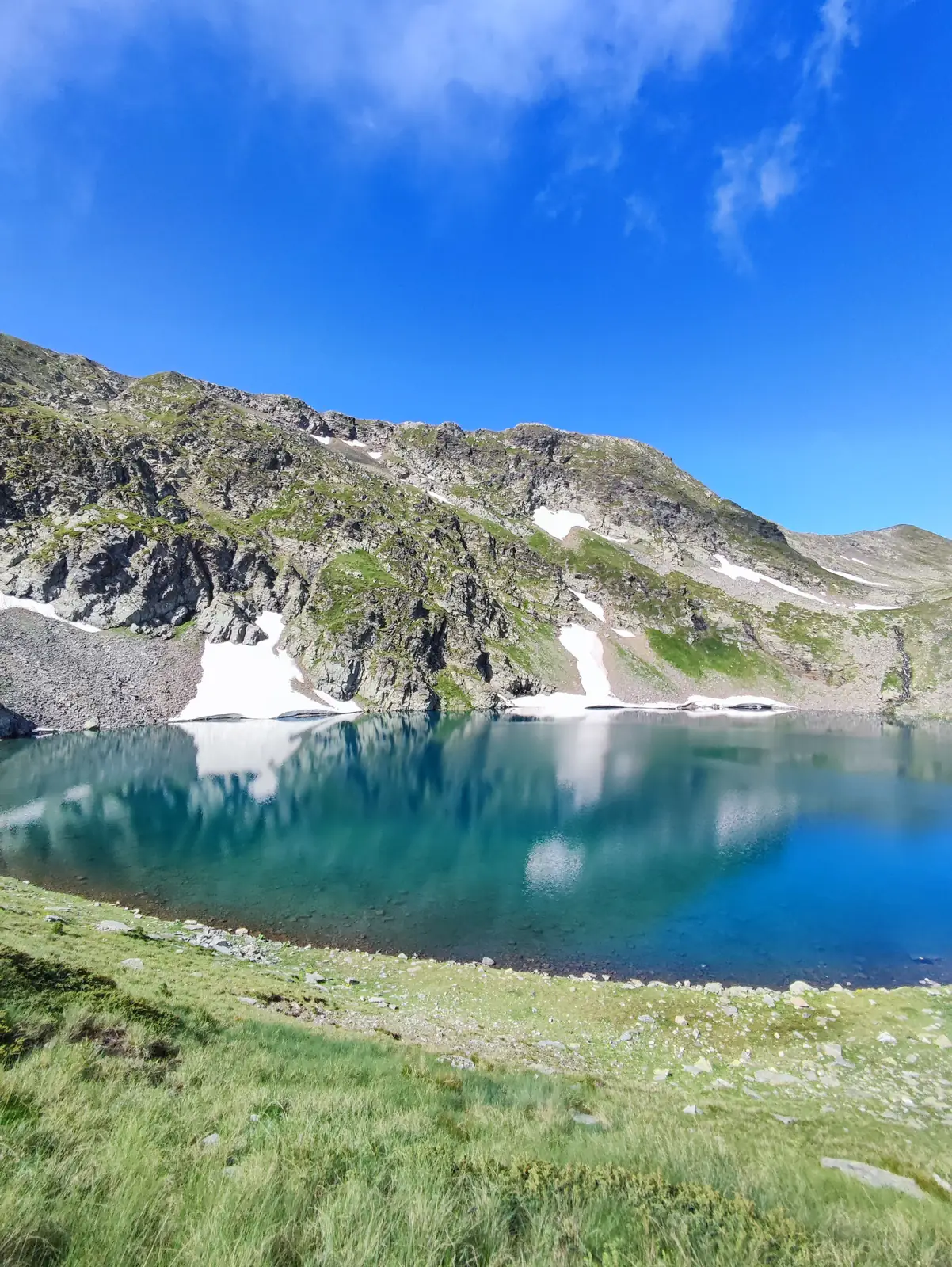
The Seven Rila Lakes are a group of glacial lakes in the Rila Mountains, spread between roughly 2,100 and 2,535 metres above sea level. Each lake has its own name based on its shape or appearance: The Tear, The Eye, The Kidney, The Twins, The Trefoil, The Fish and The Lower Lake.
The classic hike is around 10 kilometres and usually takes roughly four to five hours, although your actual time will depend on your route, pace and how many times you stop to stare at the landscape.
There is a chairlift from the Panichishte area that takes hikers up into the mountains, cutting out the lower section of the hike. From the upper station, the trails are well marked and lead through alpine meadows and rocky terrain toward the lakes.
The higher you climb, the better the views become.
The lakes almost seem stacked into the mountain, with each one revealing itself as you move higher. The Eye is particularly striking because of its deep blue colour and nearly perfect shape, while the Tear sits at the highest elevation of the seven.
For me, the best part wasn’t ticking seven lakes off a list.
It was simply being up there for the entire day.
Mountains everywhere, clear air, long views and that feeling of being very, very far away from whatever was happening down below.
If you’re planning a Bulgaria hiking trip, I would absolutely put the Seven Rila Lakes near the top of the list.
And if you’re going in summer, start early. The mountains are beautiful, but you’re definitely not the only person who has discovered them.

Sofia: One Rainy Evening in the Capital
After the mountains, I headed to Sofia.
I only spent one day there, so I’m not going to pretend I can give you the ultimate Sofia travel guide.
I can’t.
But I really liked what I saw.
Sofia is a city with a strange and beautiful mix of architecture, old churches, grand buildings, cafés, bars and busy streets. And somehow, my favourite memory of it involved rain.
It was slightly raining that evening, and the famous yellow paving stones were completely shiny from the water.
Everything reflected the streetlights.
It was ridiculously pretty.
The yellow paving stones are one of Sofia’s most recognizable features. They were installed in the early 20th century and were made from ceramic material imported from Austria-Hungary.
Walking over them in the rain immediately made me think of the famous yellow brick road from The Wizard of Oz.
Apparently my brain had decided Sofia was Oz for the evening.
There are also plenty of cafés, bars and restaurants around the city, and I could easily see why people spend several days here.
For me, though, one day was enough.
Sometimes I don’t need to see every museum, every church and every neighbourhood of a city.
Sometimes I just need a rainy evening, a pretty street and a good walk.
Belogradchik Rocks: Hiking Through Giant Rock Formations
From Sofia, I headed to Belogradchik in northwestern Bulgaria to see the famous Belogradchik Rocks.
And these were another one of those places that stayed in my memory.
The Belogradchik Rocks are a huge natural rock complex stretching for around 30 kilometres through the area around Belogradchik. The reddish formations were shaped by erosion over more than 200 million years, and some rise more than 100 metres above the surrounding landscape.
They’re made primarily of sandstone and limestone, with their characteristic reddish colour coming from iron oxide in the rocks.
But honestly, you don’t really need to know the geology to appreciate them.
You just need to walk among them.
The formations look completely different depending on where you’re standing. Some resemble towers, walls or strange giant figures, and several have names inspired by people, animals and mythical characters.
There is also the Belogradchik Fortress, which was built directly into the natural rock formations.
For me, it was another memorable hike.
After the wide-open alpine landscape of the Seven Rila Lakes, Belogradchik felt completely different. Instead of climbing through mountains toward lakes, I was wandering between enormous reddish rock formations.
It’s exactly the kind of place I love finding while travelling because it doesn’t look like anywhere else I’ve just been.

My Experience Travelling Bulgaria
I won’t pretend I travelled all over Bulgaria.
I didn’t.
I only visited Bansko, the Seven Rila Lakes, Sofia and Belogradchik.
But that was enough to give me a pretty good little taste of the country, and the landscapes were surprisingly varied.
I went from a ski town in the Pirin Mountains to glacial lakes high in the Rila Mountains, then to the capital and finally to these enormous rock formations in the northwest.
One thing I did notice during my time in Bulgaria was that I sometimes found people a little reserved with me as a tourist, particularly when I didn’t have a local connection.
That was just my personal experience, though, and I wouldn’t generalize it to Bulgarian people as a whole.
Interestingly, I had a Bulgarian friend, and everything felt completely different when I was with her. People seemed warmer and interactions felt much easier.
It reminded me once again of something I’ve noticed throughout my travels: having even one local connection can completely change the way you experience a country.
Travelling Bulgaria With a Dog
Travelling Bulgaria with Karma was quite easy for me.
Because Bulgaria is part of the European Union, travelling with a dog between EU countries follows the common EU pet-travel rules. For travel within the EU, dogs generally need to be microchipped and have a valid rabies vaccination, along with the required pet documentation.
Karma was already travelling with me in Europe, so Bulgaria didn’t create any particular headache for us.
And once we were there, travelling with a dog was pretty straightforward.
The hikes were obviously the highlight for us. The Seven Rila Lakes and Belogradchik gave us plenty of time outdoors, and I didn’t have any major issues travelling around with her.
I also found that some restaurants were happy to let her join me, although, as always when travelling with a dog, it’s better to check before sitting down.
For me, Bulgaria was another reminder that having a dog doesn’t necessarily mean giving up adventure travel.
You just have to build your itinerary around places where she can actually enjoy being there too.

Would I Visit Bulgaria Again?
Yes, especially because I feel like I only scratched the surface.
The next time I visit, I’d love to head toward the Bulgarian Black Sea coast and spend more time exploring the country beyond the mountains and the places I saw on this trip.
I would also love to come back to Bansko in winter.
Not for the hot showers this time.
For the snowboarding.
Bulgaria surprised me with how much variety I could find in such a short trip. Mountain towns, alpine lakes, a lively capital and giant rock formations all made their way into a few days of travelling.
I didn’t see all of Bulgaria.
But sometimes a country doesn’t need to give you everything for you to want to come back.
Related Posts
- Montenegro Van Life: Travel Guide & Road Trip Through Eastern Europe
- Kosovo Travel Guide: Waterfalls, Pristina & Van Life
- North Macedonia: Skopje, Alexander the Great & Life on the Road

Don’t be shy!